Many of Canada’s dams and other river barriers were constructed during the high-modernist period (mid-20th century) when controlling nature was a priority and symbol of progress. Today, these barriers are reaching the end of their functional lifespans, providing opportunities to rethink our relationships with obstructed river systems. When considering how best to modify existing dam infrastructure, options typically include repair, reconstruction, or removal. Removal is often associated with the greatest ecological benefits. However, removals are also often locally contested, leading to costly delays or a decision to fall back on the status quo and maintain the dam infrastructures.
Dams contribute to incredibly complex social-ecological systems, meaning there will be trade-offs regardless of which decision is made. To understand these trade-offs, many studies have been conducted about the biophysical impacts of dam removals. Research about the social impacts, however, are few and far between. The human dimensions of barrier removal have only recently received attention in academic literature, and most studies assess local peoples’ relationships with dammed rivers before or after dam removals. This focus on pre- or post- assessment has left a gap in our understanding of how people experience dam removal interventions over time, and whether their experiences impact social license (ongoing opposition or support for a plan or project). I sought to fill this gap by conducting a comparative study of two dammed tidal rivers—the Petitcodiac River in New Brunswick, where a causeway was partially removed and tidal flow was re-established, and the Avon River in Nova Scotia, where at the time of this study, causeway modifications were under consideration.
For this comparative study, I applied the Comparative Social Impact Assessment (CSIA) framework and used mixed methods (media and document analysis, key informant interviews, and resident surveys) to develop a comprehensive understanding of social impacts as they are felt and experienced by residents (Margeson, 2026). CSIA was designed to anticipate change from the current state to a future state at an impact site (Avon), drawing on comparative case material from a similar project that had already taken place (Petitcodiac). Despite being well established in the impact assessment literature, CSIA remains underutilized. Challenges in finding comparative sites and anticipating impacts at one site, let alone determining whether they are transferable to a second, likely accounts for the restricted use of CSIA. Recognizing these limitations, I proposed that CSIA’s potential lies in the benefits of comparing cases, including identifying temporal patterns and monitoring social impacts.
Social impacts are often broadly felt, and this study specifically focused on how people’s relationships with the landscapes coevolved, including current uses/experiences and landscape perceptions as factors that may influence social license for dam removal and river restoration in the Avon case going forward. The objectives of this research were to: 1) look backward to assess how residents’ connections to and uses of the restricted tidal rivers and estuaries developed over time with landscape change and infrastructure development; 2) determine how present uses, experiences, and perceptions of landscape change influence social license for restoring tidal connectivity; and 3) look forward by assessing cognitive and affective social impacts (i.e., attitudes and perceptions) of the intervention to modify the Petitcodiac River causeway to provide insights about the similar case evolving in the Avon River context. I relied on different combinations of datasets and analyses to address each objective, which I have summarized below.
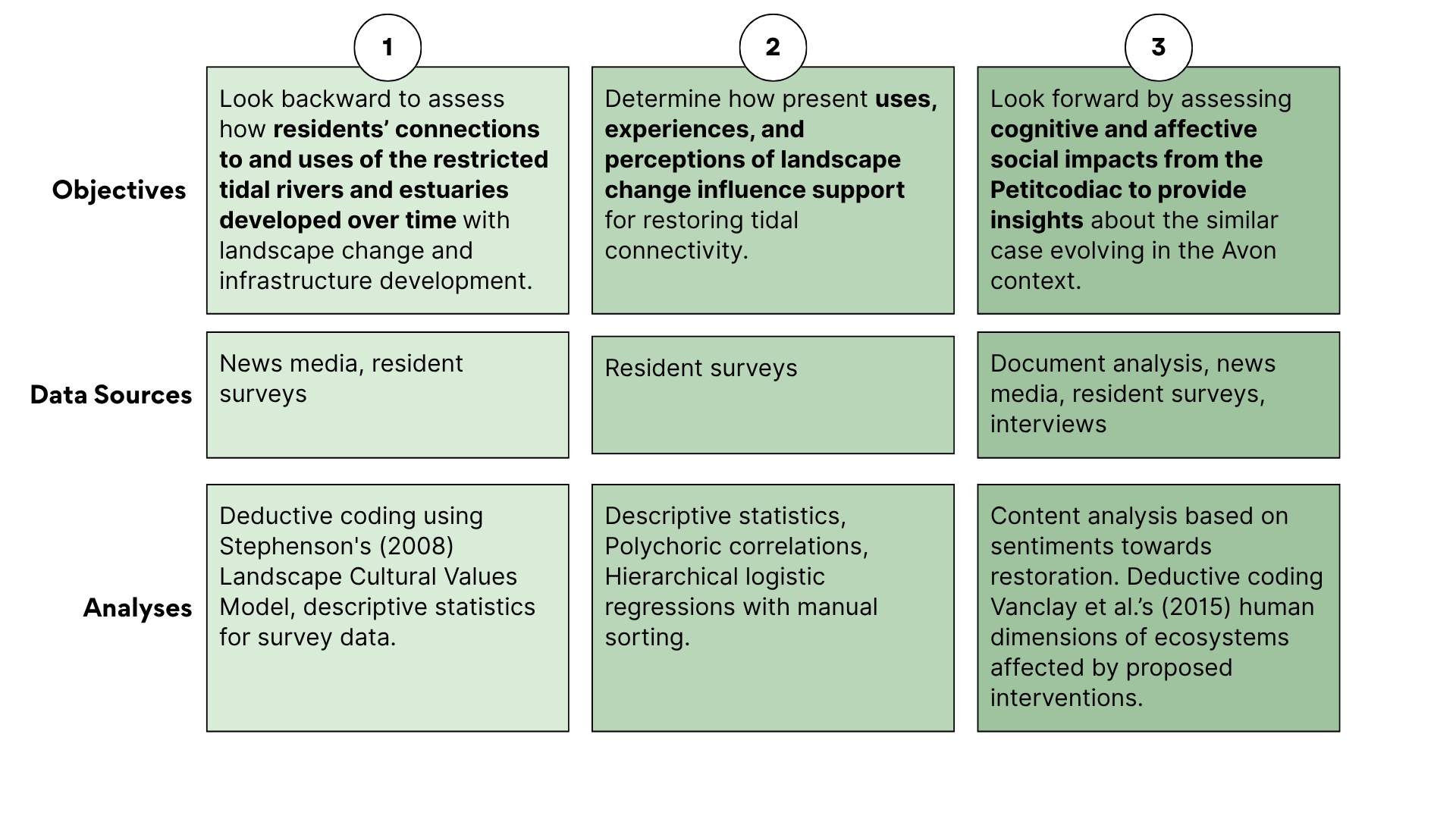 Each objective generated its own output. The objectives are described below and in expanded format as manuscripts that are currently being prepared for academic journals or are in review.
Objective 1:
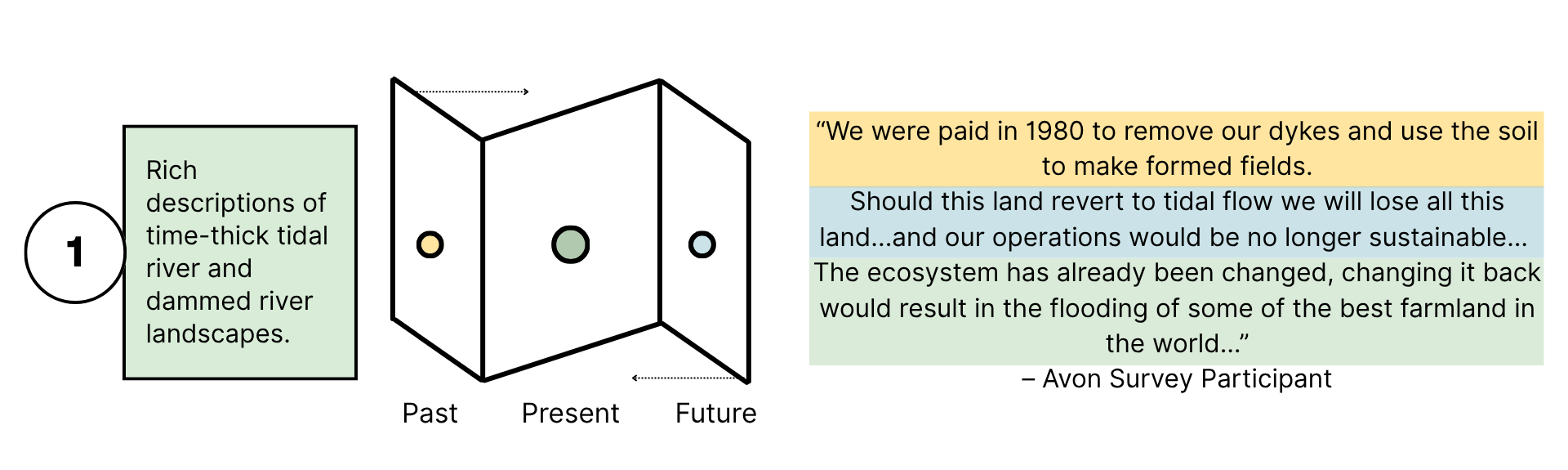
With objective one, I began by establishing a baseline understanding about uses, experiences, and perceptions of the dammed and tidal river landscapes up to the present. By looking at relational dimensions of the landscape over time, I found distinct use patterns. In the current reference period, similar proportions of the Avon and Petitcodiac area respondents experienced the landscape in non-tangible ways (e.g., enjoying the view, being in nature, walking on trails), despite the rivers being in different landscape states. Interestingly, the Petitcodiac respondents valued the tidal river landscape for the same reasons that the Avon respondents valued the lake created by the causeway. Additionally, very few Petitcodiac respondents mentioned the lake, which no longer exists since the tidal flow of the river has been restored, even when they described how they experienced the dammed river. In their descriptions of the sites, residents at both sites reflected on memories and stories from the past and expectations for the future to contextualize the present landscape. Their responses demonstrate that the tidal river landscapes are time-thick, and that decisions that will impact the landscapes must account for peoples’ relationships with place.
Objective 2:
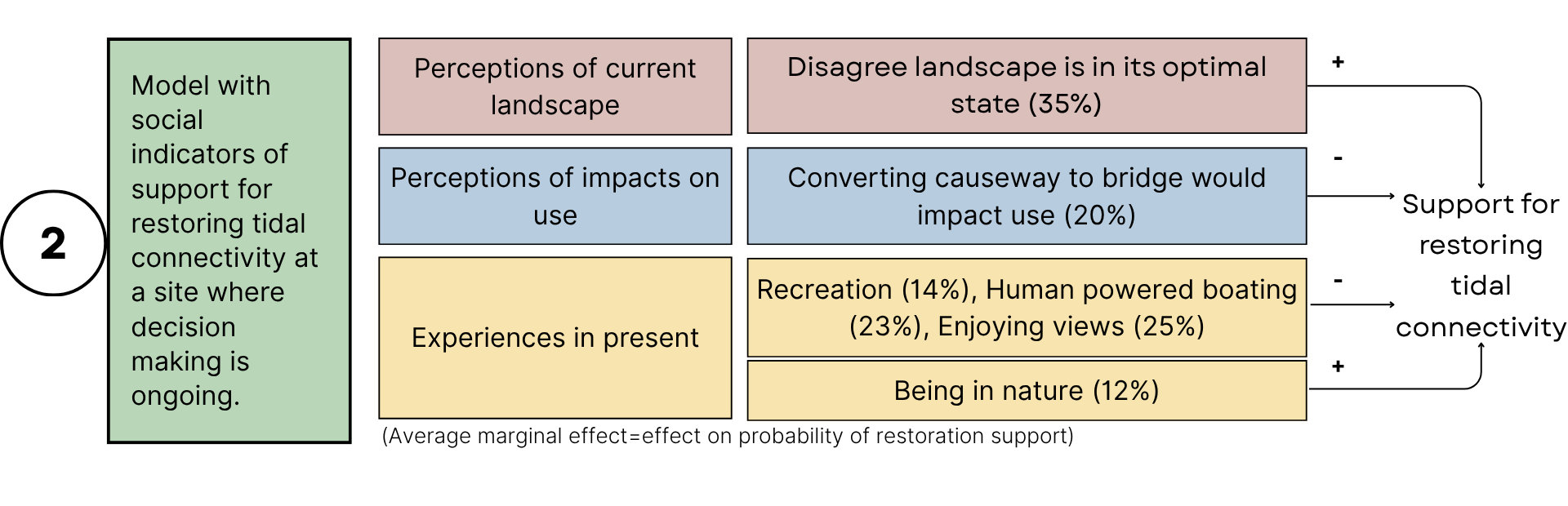
My goal with objective two was to determine whether uses, experiences, and present perceptions of landscape changes influence support for restoring tidal connectivity. Personal, experience, and perception-based factors have been found to impact restoration support in other settings and, therefore, provided a useful basis for exploring indicators of support for restoring tidal connectivity. The findings from hierarchical logistical regression modeling of the survey data indicate that at a site where restoration is proposed, i.e., the Avon site, a combination of demographic, use/experience, and perception variables influence support for restoration. In taking a comparative approach, I sought to provide insights into indicators of support throughout the restoration cycle. However, the model was not significant when it was applied to the Petitcodiac, likely due to weaker sentiments towards the restoration overall. While unable to compare indicators between sites, I was able to establish that social indicators of support for restoring tidal connection are measurable and the strongest among them are landscape perceptions.
Objective 3: 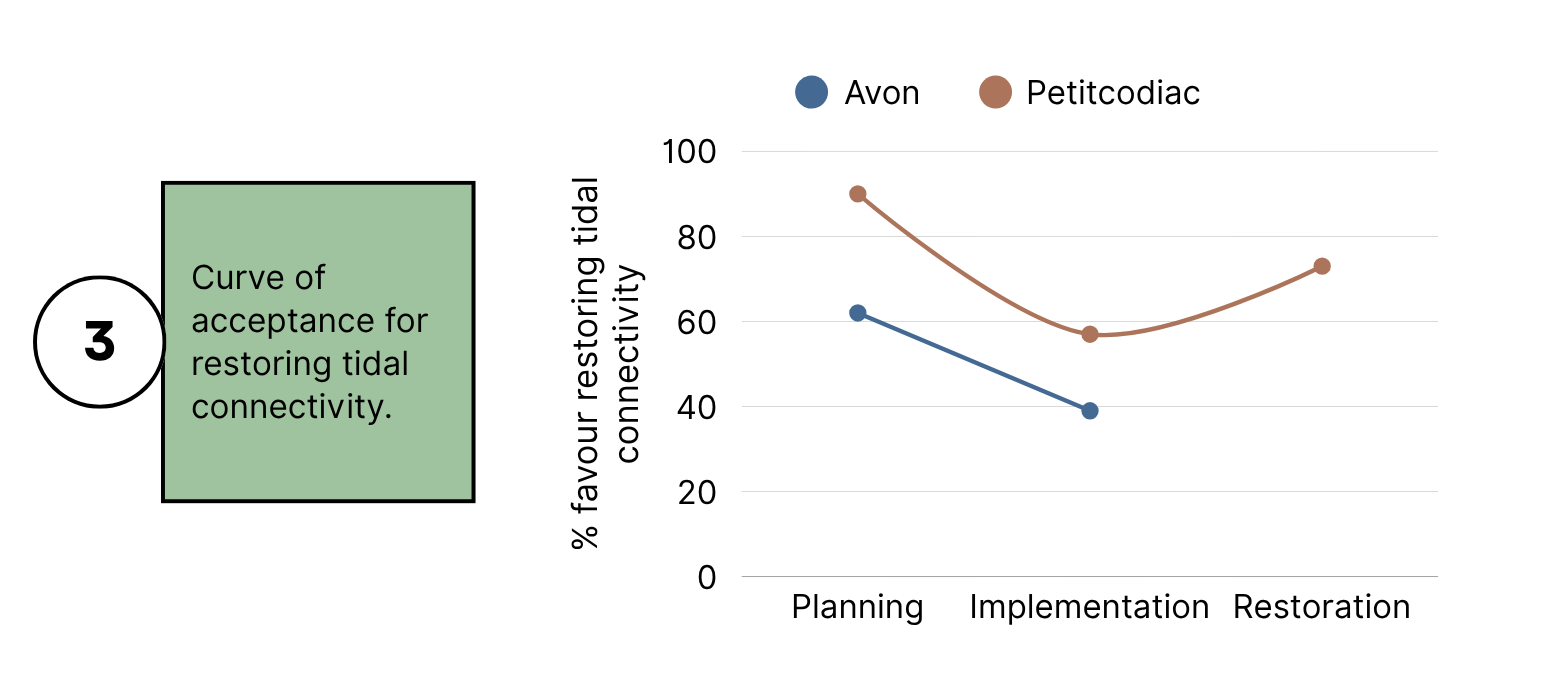
The goal with the third objective was to look forward by applying the findings from the Petitcodiac case to the similar case evolving in the Avon River context. I specifically focused on impacts associated with the interventions to modify the built infrastructure. The results show a U-shaped curve of public acceptance in the Petitcodiac case, similar to research on attitudes towards wind energy (Wolsink 2007). Attitudes towards restoration were high during planning, decreased during implementation, and increased again in the post-bridge construction period. The first two stages have been similarly reflected in the Avon case. In the Petitcodiac case, the only one where perceived post-intervention impacts could be assessed, most of the adverse impacts that people anticipated did not come to pass. The survey respondents referenced benefits for the environment and associated community cohesion as they (re)established their identity as a tidal river community. Based on the principles of the CSIA framework, notable similarities between the socio-cultural characteristics at both sites were observed. This analysis also demonstrated that even without physical changes to the causeway structure, impacts at the Avon have, thus far, mirrored the outcomes in the Petitcodiac area case study. However, a notable limitation to the comparative process is the divergence of political and governance characteristics between the sites in recent years. Interviews with Avon key informants focused heavily on what felt like an engaged design process to a top-down push to maintain the lake landscape, and the use of political levers such as indefinitely renewing an Emergency Order to do so.
Three major take-aways from this study are based on the synthesis of the findings across each objective. The first is that landscape values in times of transition require an understanding of the past and expectations for the future, as well as present uses and preferences. The second is that social indicators of support for restoring tidal connection are measurable for ongoing, contentious decisions and strongest among them are landscape perceptions. Finally, the third confirmed that comparative social impact assessment is an effective way to understand experienced social impacts and social acceptance over time during management changes. Rather than anticipating outcomes, the main advantage of the approach used in this research is building understanding about perceptions, concerns, and expectations when river barriers are modified. This approach can be included in other assessment processes to better account for felt and experienced impacts and to monitor the impacts of removing dams and other barriers. Learning from the Avon and Petitcodiac cases can contribute to progress in improving infrastructure adaptation and river restoration outcomes elsewhere, which will benefit both people and the environment.
References
Margeson, K. (2026). Using comparative social impact assessment to understand resistance and support for causeway removal and tidal river restoration. [Doctoral dissertation, Dalhousie University].
Stephenson, J. (2008). The cultural values model: An integrated approach to values in landscapes. Landscape and Urban Planning, 84(2): 127–139. https://doi.org/10.1016/j.landurbplan.2007.07.003.
Vanclay, F., Esteves, A. M., Aucamp, I., & Franks, D. M. (2015). Social impact assessment: Guidance for assessing and managing the social impacts of projects. International Association for Impact Assessment. https://iaia.org/social-impact-assessment-guidance/
Wolsink, M. (2007). Wind power implementation: The nature of public attitudes: Equity and fairness instead of “Backyard Motives.” Renewable and Sustainable Energy Reviews, 11(6): 1188–1207. https://doi.org/10.1016/j.rser.2005.10.005.
Author: Keahna Margeson
 Keahna Margeson is an environmental social scientist who holds an Interdisciplinary PhD from Dalhousie University, where she conducted the research described above. She is interested in “pracademic” work that bridges the gap between academic study and real-world applications. Her research interests include new approaches for holistic social impact assessment, ethical engagement and collaboration, and restoration and conservation as nature-based solutions for flood and erosion risk management.
Images: All figures in this post were created by Keahna Margeson.
Tags: Information Use & Influence; Public Policy and Decision Making