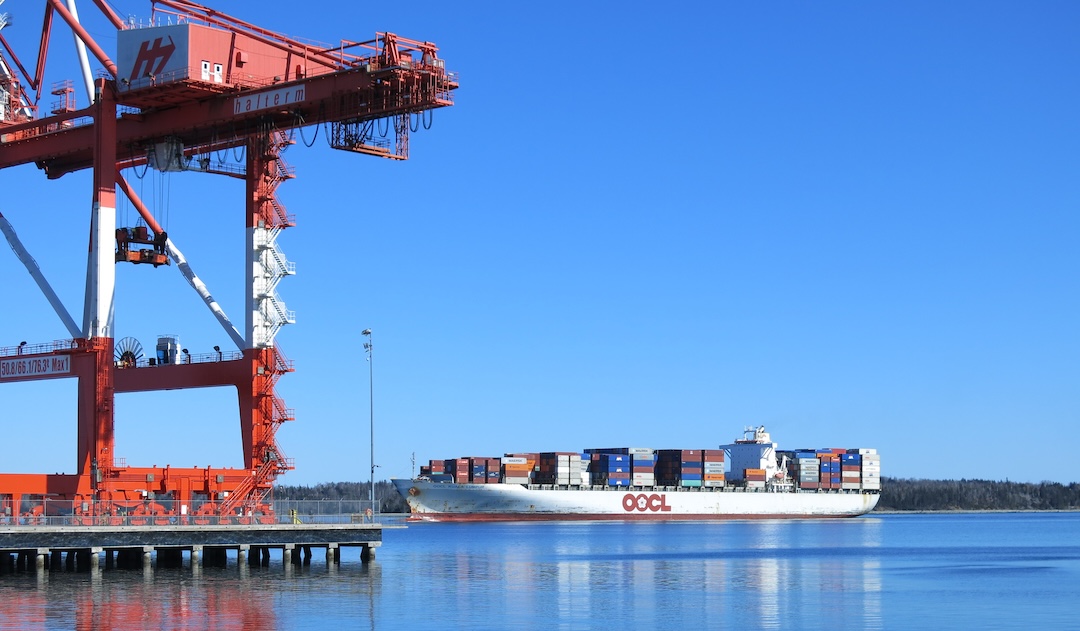
Ocean assets are estimated to provide up to US$24 trillion globally and ocean services are valued between US$1.5 trillion and US$6 trillion a year. However, the current rate of ocean resource exploitation risks a potential impact of US$8.4 trillion across ocean sectors over a 15-year period (Haugan et al., 2024). Excessive economic activity and systemic failure to recognize the ocean’s inherent value has already resulted in declining ocean health. The over exploitation of ocean ecosystems creates risk for the very businesses and economic systems that depend on them (Jones et al., 2026).
To continue benefitting from the ocean’s resources, humanity’s relationship with the ocean must change. The current largely one-sided, extractive relationship with the ocean has led to considerable loss in biodiversity and ecosystem function (IBEPS, 2019). The global economy must move toward a two-way relationship grounded in reciprocity. A reciprocal relationship recognizes that humans are an integral part of natural systems and includes interactions that create positive feedback loops that benefit both people and nature (Alvarez et al., 2025). This type of relationship is most often practiced at the community scale, and especially within Indigenous communities. However, we must find a way to incentivize a reciprocal relationship with the ocean at the global level so that large scale, extractive industries are required to positively impact ocean health. Creating an enabling environment that provides incentives for a reciprocal relationship could align what is profitable with what is good for the ocean and society (Jones et al., 2026). Businesses and financial institutions could become agents of change in the transition to a just and sustainable relationship with the ocean by addressing their impacts on biodiversity loss, climate change, and pollution, which are all connected.
The need to reimagine humanity’s relationship with the ocean is being recognized on the global stage through bodies such as the UN Ocean Decade and the Intergovernmental Science-Policy Platform on Biodiversity and Ecosystem Services (IBPES). The UN Ocean Decade Challenge 4 – develop a sustainable and equitable ocean economy – states that ocean business must contribute positively to the ocean economy while ensuring the well being of marine ecosystems and local communities. A key message of the recent IBPES Business and Biodiversity Assessment is that all businesses depend on biodiversity and can be agents of positive impact (Jones et al., 2026). The UN and IBPES describe a “blue economy” approach, which was defined by the World Bank and United Nations Department of Economic and Social Affairs in 2017 as the sustainable use of ocean resources for economic growth, improved livelihoods, and job creation while preserving the health of the ocean (World Bank & United Nations Department of Economic and Social Affairs, 2017).
Uniquely, the blue economy recognizes that economic success relies on a healthy ocean, and that both people and the ocean must benefit from the interactions. Canada, and many other countries, have committed to fostering and achieving the blue economy within their jurisdictions (Noonan-Birch et al., 2024). However, a standardized approach for transitioning from the current ocean economy to a blue economy does not exist. For the blue economy to be an effective, sustainable alternative clear criteria for ocean industries to adhere to are needed. These criteria must support goals for social equity, environmental sustainability, and economic prosperity. Without clear criteria, “blue washing” can occur, which can mean that the inability to assess a company’s compliance with blue economy tenets turns the application of the concept into an empty promise made by ocean businesses.
I addressed the challenge of developing blue economy criteria for ocean businesses in my Master of Environmental Studies thesis, “Applying the SDGs in a framework to assess blue economy capacity of industry operators in Canada” (Noonan-Birch, 2023), subsequently published as an article in Frontiers in Marine Science (Noonan-Birch et al., 2024). The UN Sustainable Development Goals (SDGs) offer an ideal foundation from which to develop blue economy criteria because of the integrated way in which they span social, economic, and environmental priorities. In my research, I developed the Blue Economy Capacity Framework (BECF) to link the theoretical nature of the SDGs to practical actions that an ocean business can take to contribute to Canada’s blue economy. An ocean business can then be evaluated on these actions to determine its blue economy capacity (BEC) and measure its credibility as a blue economy company.
Blue Economy Capacity Framework
In developing the BECF, the 169 SDG targets were first reduced to 10 determined to be relevant to Canada’s blue economy. This step was completed through a criteria-based approach (see Table 1). This method contextualized the SDGs to Canada’s blue economy and ensured that the selected SDG targets reflected interdependencies among the SDGs (see Noonan-Birch et al., 2024 for the list of selected targets).
Next, the selected SDG targets were analyzed to clarify how they might economically incentivize an ocean business to positively impact ocean health. Through this analysis four overarching themes emerged as blue economy industry aims, and the SDG targets were categorized into each of the aims. The final step in creating the BECF entailed the development of enabling mechanisms, which are the actions that an ocean company can take to positively impact ocean health and thus increase the company’s blue economy capacity.
Table 1: Definitions of the criteria for SDG targets and selection examples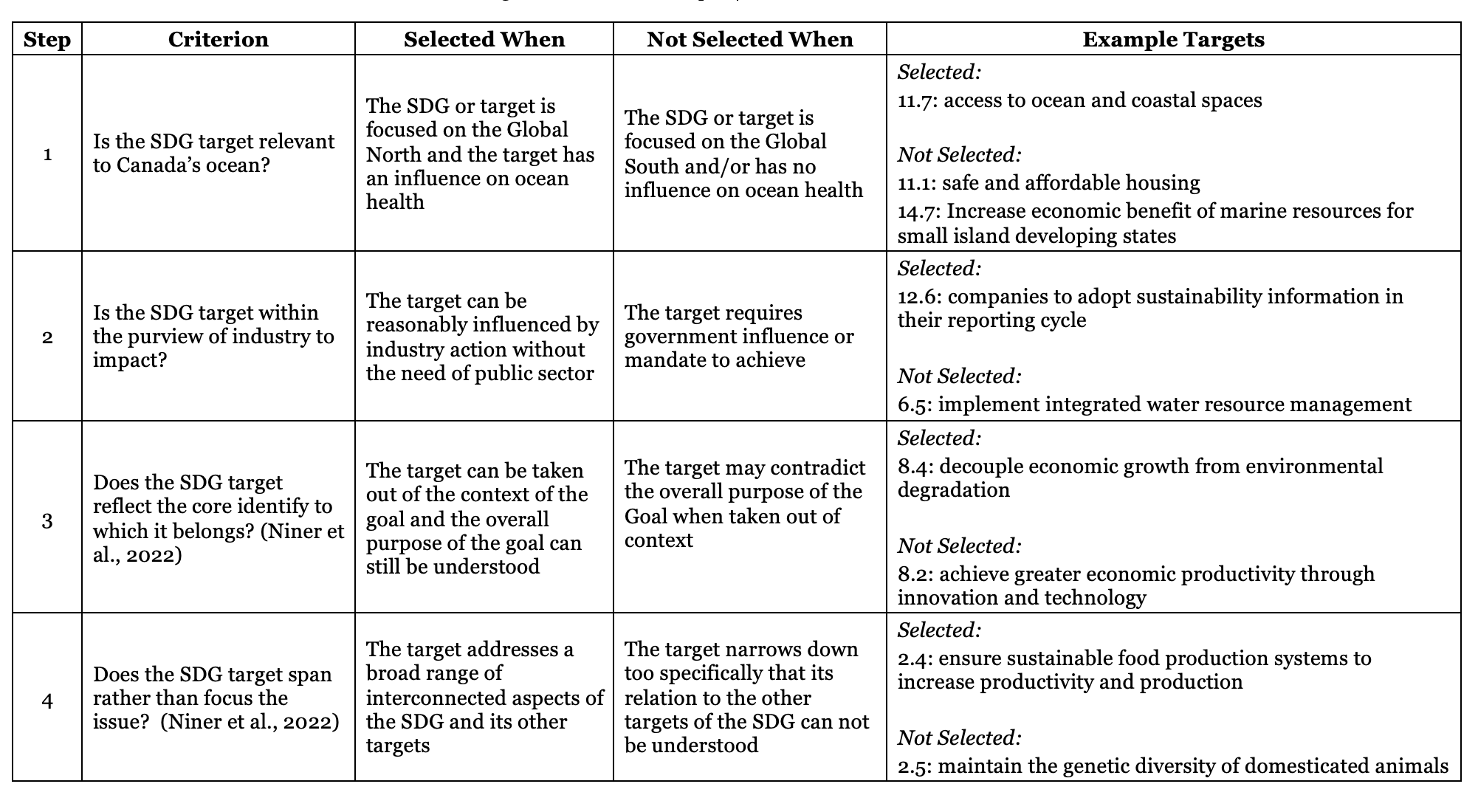
Blue Economy Industry Aims
Associating an economic incentive with each selected SDG target increases the likelihood that companies will adopt the enabling mechanisms (Noonan-Birch et al., 2024). The BECF contains four blue economy industry aims: ocean health investment (OHI), social license to operate (SLO), gender equity (GE), and highly qualified personnel (HQP) and several enabling mechanisms are associated with each aim. For example, a company that relies on a healthy ocean for economic success, benefits from investing in the protection and restoration of ecosystems critical to ocean health. Therefore, the enabling mechanisms for investments in ocean health include actions such as identifying the ecosystems a company relies on (both directly and indirectly) and the ability to distinguish and measure the company’s impact on those ecosystems (see Table 2).
Table 2: Mechanisms adapted from Richter et al. (2021) and Haines-Young et al. (2018) that enable the Blue Economy Aim, Ocean Health Investment, and address the relevant SDGs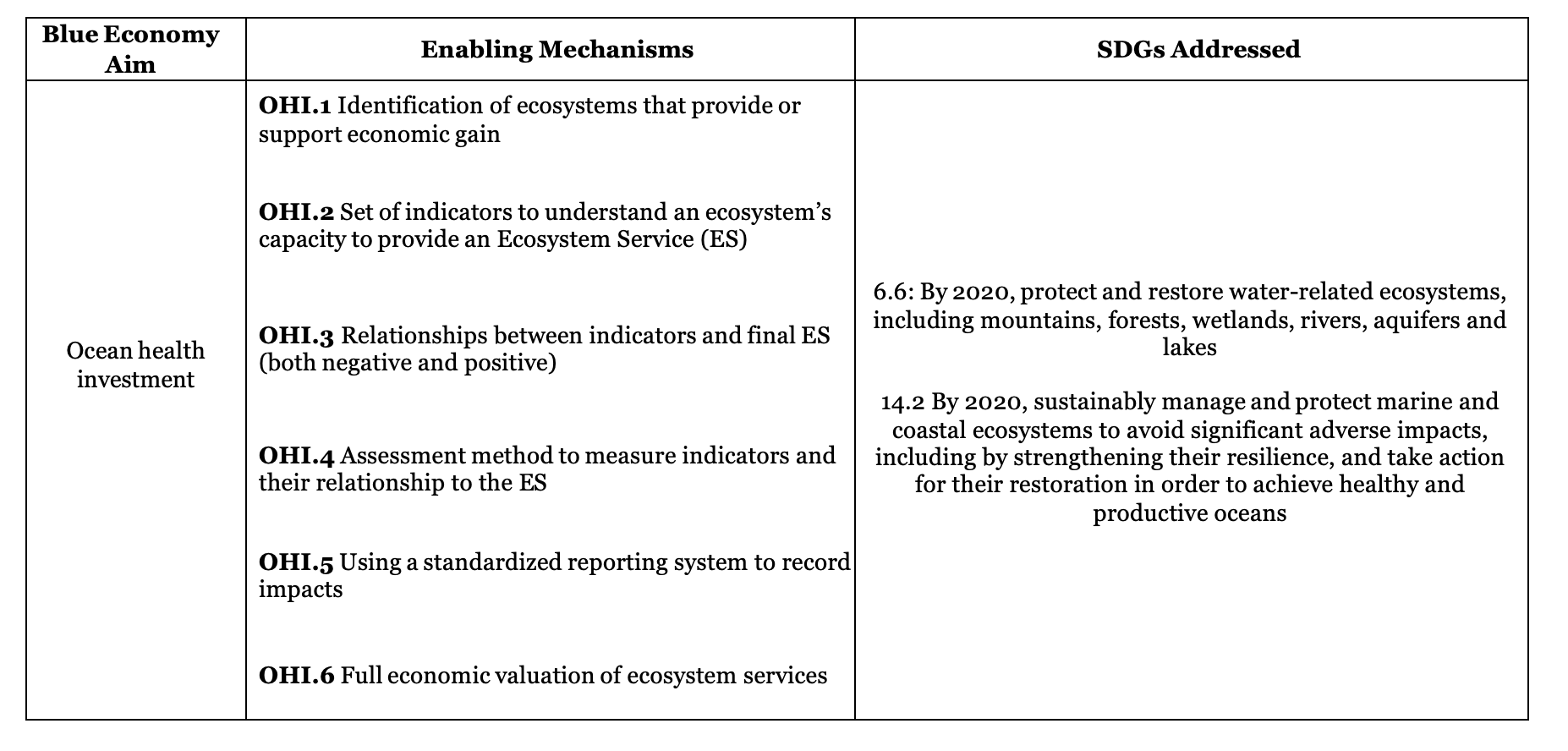
Obtaining and maintaining social license to operate is economically beneficial to a company because this social support is needed to ensure the ongoing viability of projects and achieve political and social capital. Enabling mechanisms for this industry aim include conducting stakeholder and rightsholder engagement exercises to address concerns of benefit sharing that may be expressed by the stakeholders and rightsholders. Companies that implement gender equity practices often see increased profitability and productivity. Enabling mechanisms to evaluate this industry aim include increasing the opportunity for employment of women. Blue economy companies must attract and retain HQP to be economically viable. Thus, enabling mechanisms include creating opportunities for early career ocean professionals. The full list of enabling mechanisms is set out in Noonan-Birch, 2024. The blue economy aims and their associated enabling mechanisms provide criteria for businesses to assess and adhere to blue economy status. By applying the BECF a distinction is created between the current ocean economy and the aspirational blue economy.
Implementation
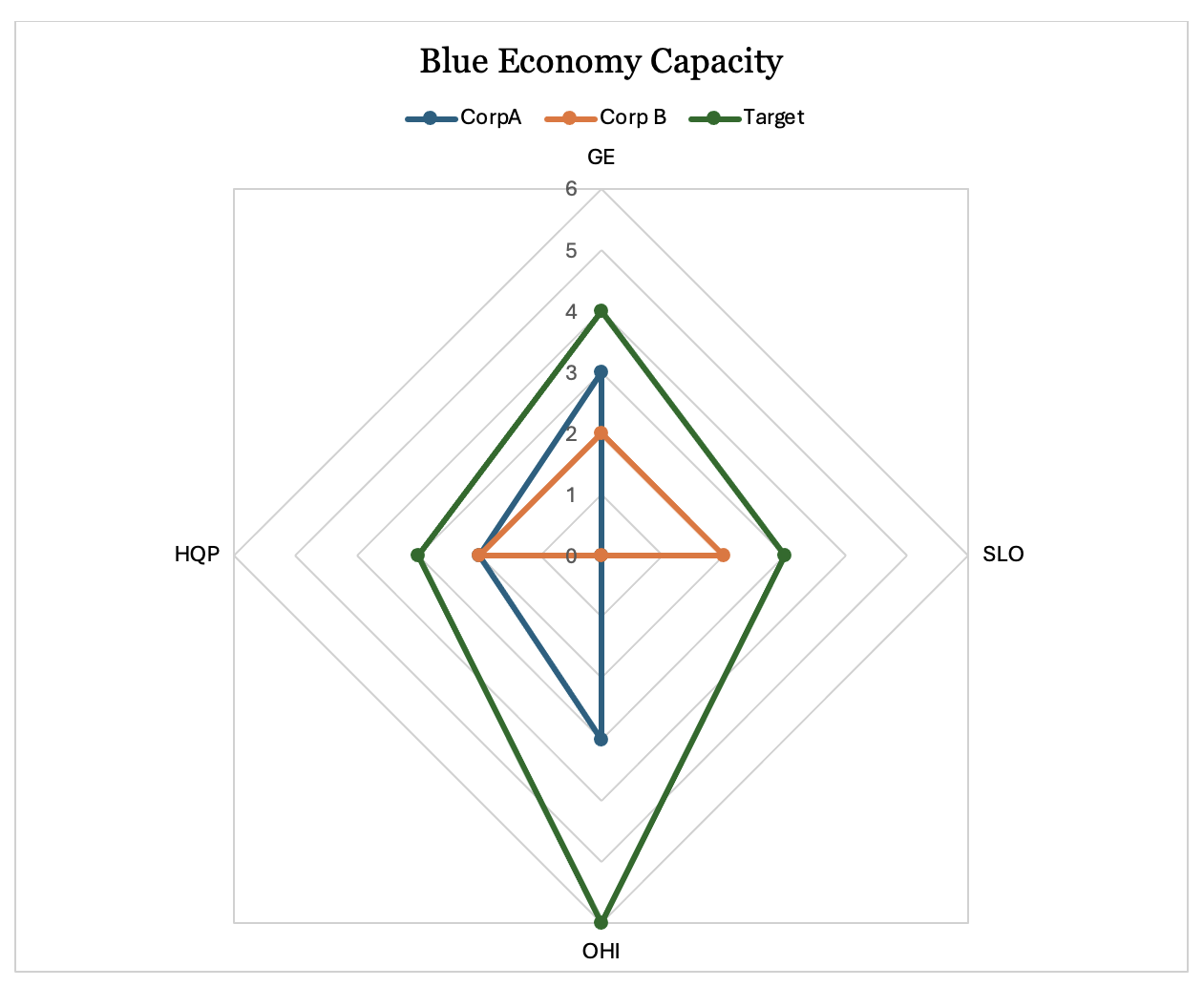
The criteria developed in the BECF could be used in a blue economy accreditation process. A company with a higher blue economy capacity could be more desirable as an investment option. During my master’s research, I interviewed executives from two companies to determine which of the enabling mechanisms they implement in their respective organizations (Figure 1). The results of the interviews provided an illustrative example of how the criteria developed in the BECF might be used as a benchmarking and comparison tool to determine a company’s blue economy capacity (Noonan-Birch, 2023).
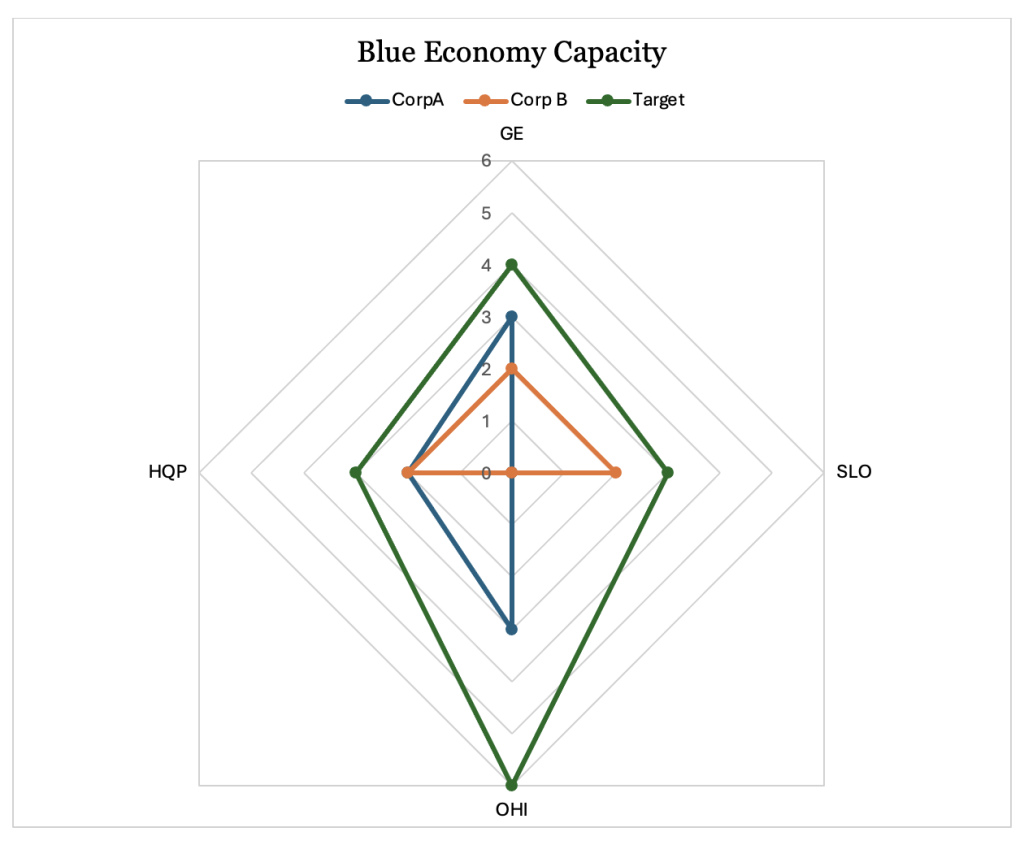 Figure 1: The blue economy capacity of CorpA and CorpB determined by the number of mechanisms implemented in each blue economy aim. A Target example is used for comparison that implements all mechanisms in each of the blue economy aims: ocean health investment (OHI), highly qualified personnel (HQP), gender equity (GE), and social licence to operate (SLO)
The criteria developed in the BECF could be used to inform Canada’s transition away from an ocean economy to a blue economy. Ocean Decade Challenge 4 recommends that national governments establish dedicated financial mechanisms to support organizations in enabling social equity, environmental sustainability, and economic viability across ocean sectors. The Canadian government could satisfy this recommendation by adopting the BECF criteria to determine which ocean businesses to award funding to based on their blue economy capacity. Furthermore, Ocean Decade Challenge 4 recommends that ocean businesses themselves must positively contribute to the ocean economy while ensuring the well-being of marine ecosystems and local communities. The BECF provides criteria for companies to assess their contributions to this recommendation. In its assessment of the impact of business on biodiversity IPBES found that there are inadequate incentives for businesses to positively impact ecosystems. The BECF addresses this problem by developing enabling mechanisms based on the economic incentive to fulfill the SDG targets. The BECF provides a method to help direct private sector funds to support ocean health and to promote a reciprocal relationship with the ocean.
References
Alvarez, R., Caniullán, D., Catín, J., Cheuquenao, P., Coñuecar, Y., Diestre, F., Jara, P., Millatureo, N., Vargas, D., & Ojeda, J. (2025). Reciprocal contributions: Indigenous perspectives and voices on marine-coastal experiences in the channels of northern Patagonia, Chile. People and Nature, 7, 1086-1098. https://doi.org/10.1002/pan3.70004
Haines-Young, R. & Potschin, M. B. (2018): Common international classification of ecosystem services (CICES) V5.1 and Guidance on the application of the revised structure. https://cices.eu/content/uploads/sites/8/2018/01/Guidance-V51-01012018.pdf
Haugan, P., Rhodes, A., Hollaway, L., James, P., Abdul Rahman, M., Appiott, J., DeBeauville-Scott, S., Gelcich, S., Gericksky, E., Gonzales-Quiros, R., Harms, E., Heaps, L., Hospes E., Jeremie, M. M., Jumbe, A. S., Kostka, W. N., Mokenye, J., Noonan-Birch, R., Park, G., Solis Rivera, V. & Thiele, T. (2024). Ocean decade vision 2030 white papers – Challenge 4: Develop a sustainable and equitable ocean economy. (51.4; The Ocean Decade Series, p. 26). Paris, UNESCO-IOC. https://doi.org/10.25607/2452-1r10
IPBES. (2019). Summary for policymakers of the global assessment report on biodiversity and ecosystem services (S. Díaz, J. Settele, E. S. Brondízio, H. T. Ngo, M. Guèze, J. Agard, A. Arneth, P. Balvanera, K. A. Brauman, S. H. M. Butchart, K. M. A. Chan, L. A. Garibaldi, K. I. J. Liu, S. M. Subramanian, G. F. Midgley, P. Miloslavich, Z. Molnár, D. Obura, A. Pfaff, … C. N. Zayas, Eds.; Version summary for policy makers). Bonn: IPBES Secretariat. https://doi.org/10.5281/ZENODO.3553579
Jones, M., Polasky, S., Rueda, X., Brooks, S., Ingram, J. C., von Hase, A., Egoh, B., Kohsaka, R., Kulak, M., Leach, K., Loyola, R., Mandle, L., Rodriguez Osuna, V., Schaafsma, M., & Sonter, L. (2026). IPBES business and biodiversity assessment: Summary for policymakers. Zenodo. Bonn: IPBES Secretariat. https://doi.org/10.5281/ZENODO.20714890
Niner, H. J., Barut, N. C., Baum, T., Diz, D., Laínez Del Pozo, D., Laing, S., Lancaster, A. M. S. N., McQuaid, K. A., Mendo, T., Morgera, E., Maharaj, P. N., Okafor-Yarwood, I., Ortega-Cisneros, K., Warikandwa, T. V., & Rees, S. (2022). Issues of context, capacity and scale: Essential conditions and missing links for a sustainable blue economy. Environmental Science & Policy, 130, 25-35. https://doi.org/10.1016/j.envsci.2022.01.001
Noonan-Birch, R. (2023). Applying the SDGs in a framework to assess blue economy capacity of industry operators in Canada. [Master of Environmental Studies thesis, Dalhousie University].
Noonan-Birch, R., Adams, M., & Ross, M. C. (2024). Utilizing the SDGs to develop a blue economy capacity framework enabling a shift from an ocean economy to a blue economy in Canada. Frontiers in Marine Science, 11, 1400043. https://doi.org/10.3389/fmars.2024.1400043
Richter, F., Jan, P., El Benni, N., Lüscher, A., Buchmann, N., & Klaus, V. H. (2021). A guide to assess and value ecosystem services of grasslands. Ecosystem Services, 52, 101376. https://doi.org/10.1016/j.ecoser.2021.101376
World Bank & United Nations Department of Economic and Social Affairs. (2017). The potential of the blue economy: Increasing long-term benefits of the sustainable use of marine resources for small island developing states and coastal least developed countries. New York: World Bank. http://hdl.handle.net/10986/26843
Author: Ronnie Noonan-Birch
 Ronnie is an ocean information systems and governance researcher. Her upcoming PhD in Information at Dalhousie University will investigate the process of using ocean data to make decisions on ocean conservation and climate change. Ronnie considers herself a “boundary spanner” and enjoys working in spaces that connect knowledge production and knowledge use.
Images: Tables 1 and 2 are reprinted from Noonan-Birch et al., 2024. Figure 1 is reprinted from Noonan-Birch, 2023. The photograph of Halifax harbour and container port was provided by P. G. Wells.
Tags: Information Use & Influence; Marine & Ocean Issues; Public Policy & Decision-Making