In 2015, the member countries of the United Nations adopted Transforming our world: the 2030 Agenda for Sustainable Development. Since then, the 17 Sustainable Development Goals (SDGs) have served as an “urgent call for action by all countries – developed and developing – in a global partnership” (The 17 Goals). These goals “recognize that ending poverty and other deprivations must go hand-in-hand with strategies that improve health and education, reduce inequality, and spur economic growth – all while tackling climate change and working to preserve our oceans and forests” (The 17 Goals).
Climate change is affecting every aspect of life on Earth, as seen in increasing extreme weather events, severe biodiversity loss, rapidly rising ocean temperatures, and forced migrations. Each year the United Nations reports on progress by drawing on a “global indicator framework and data produced by national statistical systems and information collected at the regional level” (The 17 Goals). The 2025 report noted, for example, that the SDGs have “improved millions of lives, but the current pace of change is insufficient to fully achieve all the Goals by 2030.”
While each country can implement policies and support initiatives to promote awareness and collective action to achieve the SDGs, universities are particularly well-positioned as centres of education and research to advance knowledge and to investigate and test innovative solutions to the problems underlying the SDGs.
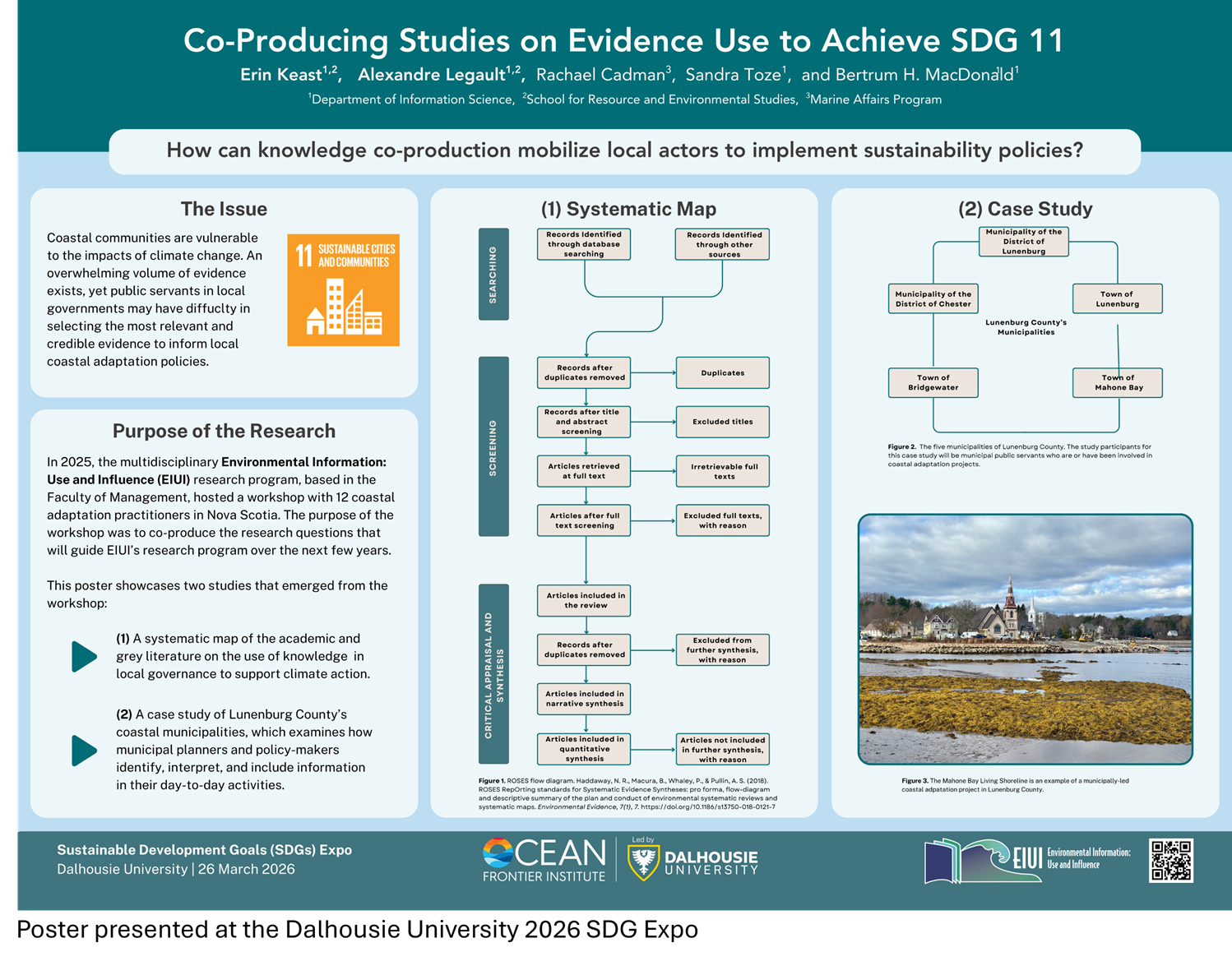
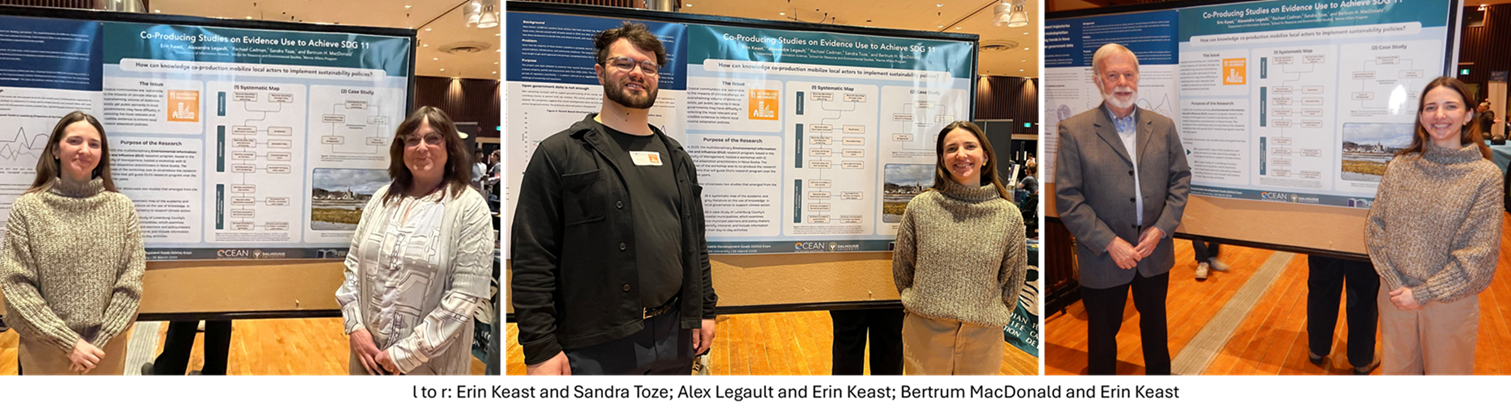
For the second year in a row, the Office of Sustainability at Dalhousie University hosted a SDGs Expo on 26 March 2026. This event was a campus-wide showcase of interdisciplinary research, innovation, and action about the SDGs, which brought students, researchers, faculty, staff, and community partners together who are “working toward a more just, resilient, and sustainable future, both on and beyond Dalhousie’s campuses” (SDGs Expo 2026). Members of the Environmental Information: Use and Influence (EIUI) research team participated in this Expo with a research poster titled “Co-Producing Studies on Evidence Use to Achieve SDG 11.”
For several decades, researchers in many countries have been studying information behaviour in public policy decision making processes, primarily to gain an understanding of the complex and often “messy” activities at science-policy interfaces. The various forms of research output from this line of research is extensive and growing. The EIUI team has contributed to this body of literature through numerous case studies conducted with governmental, intergovernmental, and non-governmental organizations.
Most of the global research has focused on national and international levels of government. Less attention has been placed on sub-national levels (provincial, state, regional) and local or municipal levels have been largely overlooked. To address the limited understanding of how evidence informs municipal decision making, the EIUI research team has begun to carry out studies that focus on this level of government.
The first case study is being conducted in Nova Scotia where the effects of climate change are directly impacting local communities. Coastal communities are particularly vulnerable to an amalgam of issues, including sea level rise, coastal erosion, warming ocean temperatures, and storm damage. Even though a large volume of evidence about climate change is available, public servants in local governments often have difficulty in selecting the most relevant and credible evidence to inform their climate adaptation decisions and policies. Drawing on the findings of a workshop that EIUI team members conducted with coastal adaptation practitioners in Nova Scotia in 2025, the research plan highlighted in the poster involves: 1) a systematic map of the global academic and grey literature about the use of evidence in local governance to support climate action, and 2) a case study of how planners and policy-makers in the municipalities of Lunenburg County identify, interpret, and include information in their decision activities (see abstract below).
This research is being conducted within the large Transforming Climate Action (TCA) project led by Dalhousie University’s Ocean Frontier Institute, in partnership with Université du Québec à Rimouski, Université Laval, and Memorial University. The EIUI team is working within Theme 3: “Just and equitable adaptation,” particularly cluster 3.2 “Towards transformative ocean-climate action and policy.” This cluster approaches the issue of declining ocean health “from an informational justice perspective, emphasizing the right by all to access information and knowledge, have equal opportunity to directly participate in the production and dissemination of information and knowledge, and have their identities and culture be recognized, respected, and fairly represented in the informational world.” Guided by this framework, the research in this cluster “addresses the fundamental question: How can we improve knowledge production, exchange, and use among diverse actors to build an understanding of ocean and climate change that enables societal mobilization towards a sustainable future?”
Poster Abstract
How can knowledge co-production mobilize diverse actors to implement sustainability policies? This question guides the Environmental Information: Use and Influence (EIUI) research group’s latest work funded by the Ocean Frontier Institute’s Transforming Climate Action research program. EIUI members study the use of knowledge at marine science-policy interfaces to develop better understanding of factors that enable and limit its uptake in public policy decisions. Science–policy interfaces are complex processes involving knowledge production, communication strategies, and policymaking across multiple governance levels. Since many actors and factors operate in these interfaces, gaps often occur between the production of knowledge and its use. EIUI’s work examines these gaps through the lens of knowledge co-production, emphasizing collaborative research processes that engage researchers alongside practitioners, policy-makers, consultants, and community organizations. This poster showcases two projects that emerge from the knowledge co-production workshop we held with twelve adaptation practitioners in July 2025: (1) a systematic map of the academic and grey literature on the use of knowledge in local governance to support climate action, and (2) a case study of Lunenburg County’s coastal municipalities, which examines how municipal planners and policy-makers identify, interpret, and include information in their day-to-day activities. The knowledge co-production process grounds our research in practitioner experience. Together, these projects contribute to SDG 11 (Sustainable Cities and Communities) and intersect with SDGs 13 (Climate Action), 14 (Life Below Water), 16 (Peace, Justice and Strong Institutions), and 17 (Partnerships for the Goals).
Authors: Erin Keast, Alexandre Legault, Rachael Cadman, Sandra Toze, & Bertrum H. MacDonald
Images: Photograph credits: Bertrum MacDonald and Peter Wells
Tags: Information Use & Influence; Public Policy & Decision-Making; Science-Policy Interface